Sunday, April 5, 2020

প্যারাডক্সিক্যাল সাজিদ ২ -আরিফ আজাদ । Paradoxical Sajid 2 by Arif Azad


Paradoxical Sajid 2(প্যারাডক্সিকাল সাজিদ ২) is a storybook about author Arif Azad’s fictional friend Sajid. In the book, Sajid argues much logic against atheism.

প্যারাডক্সিক্যাল সাজিদ ২ - Paradoxical Sajid

Download From Here

Most of the chapters are about philosophical paradoxes. There are a few chapters where Sajid talks about science and that’s where it interests me.
Although in the book Sajid says those things, in reality, those are actually the author’s arguments. If you try to categorize this book, it falls more under the non-fiction genre than fiction. Therefore, it was the author’s responsibility to fact check everything and give proper references. 

প্যারাডক্সিক্যাল সাজিদ__Paradoxical Sajid by Arif Azad


বর্তমান যুগ হলো প্রেজেন্টাশানের যুগ। একটা জিনিসকে আপনি কিভাবে, কতোটা সহজে, কতোটা সাবলীলভাবে, কতোটা মাধুর্যতায় প্রেজেন্টেশান করছেন তার উপর কিন্তু অনেক কিছুই নির্ভর করে। ন্যাচারালি, মানুষের একটা স্বভাব হচ্ছে – এরা তত্ত্বকথা খুব কম হজম করতে পারে। এরা চায় সহজবোধ্যতা। প্যারাডক্সিক্যাল সাজিদ এর লেখক আরিফ আজাদ ঠিক এই পদ্ধতিই বেছে নিয়েছেন। তিনি গতানুগতিক লেকচার বা তত্বকথার ধাঁচে না গিয়ে, বক্তব্যের বিষয়গুলোকে গল্পের ধাঁচে ফেলে সাজিয়েছেন। 

Paradoxical Sajid PDF (Part 1 & 2) By Arif Azad Free Download

Download From Here

প্রতিটি গল্পের শুরুতেই আছে মজার, আগ্রহ উদ্দীপক একটি সূচনা। কোথাও বা গল্পের কেন্দ্রীয় চরিত্র সাজিদের সাথে তাঁর বন্ধু আরিফের খুনসুটি, কোথাও বা মজার কোন স্মৃতির রোমন্থন, কোথাও বা আছে সিরিয়াস কোন ব্যাপারে সিরিয়াস কোন হুশিয়ারি। গল্পে মজা আছে, আনন্দ আছে। মোটামুটি, সার্থক গল্পে যা যা উপাদান থাকা দরকার, যা যা থাকলে পাঠকের গল্প পাঠে বিরক্তি আসেনা, রুচি হারায় না- তার সবকিছুর এক সম্মিলিত সন্নিবেশ যেন লেখক আরিফ আজাদের এই সিরিজের একেকটি এপিসোড।
গল্পে গল্পে যুক্তি খন্ডন, পাল্টা যুক্তি ছুঁড়ে দেওয়া, পরম মমতায় অবিশ্বাসের অন্ধকার দূরীকরণে এ যেন এক বিশ্বস্ত শিল্পী।

Saturday, April 4, 2020

বেলা ফুরাবার আগে__Bela Furabar Age__আরিফ আজাদ(২০২০)


বেলা ফুরাবার আগে জনপ্রিয় উদীয়মান তরুণ লেখক আরিফ আজাদ এর লেখা একটি ইসলামিক বই যা ২০২০ সালে বইমেলায় প্রকাশিত নতুন বই। ইতিমধ্যে অনলাইন বুক স্টোর গুলোতে এবং একুশে বইমেলায় বেস্ট সেলার বুকে পরিণত হয়েছে এই বইটি।
.
Bela Furabar Age PDF Download | Arif Azad Book [Read Now]


Download From Here


জীবনের কতগুলাে বসন্ত পার হয়ে গেছে, ম্লান হয়ে গেছে কতশত কাকডাকা ভাের। আবছা সুতির মতাে, জীবন আস্তে আস্তে আচ্ছন্ন হয় ধূসরতায়৷ সময়ের সরল সংখ্যা কমে আসছে। ধীরে ধীরে। সব পাখি নীড়ে ফেরে৷ সব নদী ফিরে যায় মােহনায়। তবু কিছু মানুষ, ভ্রান্তির মায়াজাল ভেদ করে, ফিরে আসতে চায় না। মােহ আর মায়ার বাঁধন ছিন্ন করে তারা ছুটতে পারে না আদিগন্ত অনন্তের পথে। তবু ফিরতে হবে। বেলা ফুরাবার আগে, ঠিক ঠিক চিনে নিতে হবে পথ সন্ধ্যের ঘনঘাের আঁধারের অতলতায় ডুবে যাবার আগে, জীবন তরিটিকে ভেড়াতে হবে কুলে৷ রাতেরও শেষ আছে৷ ক্লান্তিরও আছে অবসান। জীবনের জড়তার জোয়ার ছেড়ে, নতুন করে একবার, শুধু একবার জ্বলে উঠতে হবে। নিজেকে আরেকবার ঝালিয়ে নিতে আজ তবে ডুব দেওয়া যাক। 

Bela Furabar Age by Arif Azad is a popular Bengali Book and another popular Islamic Book of Arif Azad. The book was first published in Ekushey Book Fair 2020 from Dhaka, Bangladesh in Bengali. Arif Azad is a Bangladeshi activist and author. Both of his two books became a bestseller in Ekushe Book Fair. His first book, Paradoxical Sajid is widely celebrated in Bangladesh. It has been translated into English and Assamese. It is to be translated into several other languages. Guardian Publications gives his intro like this, ‘Arif Azad. Born in Chittagong, is a social media activist. Writes about faith, destroys the glass of unbelief. Most Popular Books of Arif Azad are Paradoxical Sajid -1, Paradoxical Sajid - 2, Aroj Ali Somipe, Sottokothon, Bela Furabar Age, etc. 

Friday, September 6, 2013

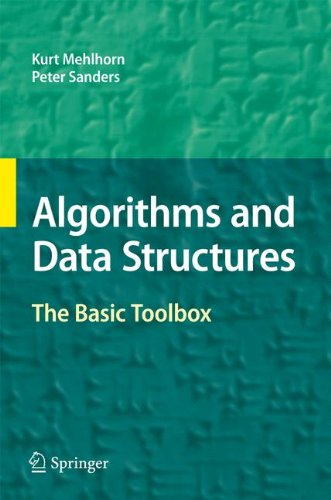
Algorithms and Data Structures: The Basic Toolbox

Algorithms and Data Structures: The Basic Toolbox

by K. Mehlhorn, P. Sanders
Publisher: Springer 2008
ISBN/ASIN: 3642096824
ISBN-13: 9783642096822
Number of pages: 300
Description:
This book is a concise introduction addressed to students and professionals familiar with programming and basic mathematical language. Individual chapters cover arrays and linked lists, hash tables and associative arrays, sorting and selection, priority queues, sorted sequences, graph representation, graph traversal, shortest paths, minimum spanning trees, and optimization.

Search Algorithms and Applications

Search Algorithms and Applications

by Nashat Mansour
Publisher: InTech 2011
ISBN-13: 9789533071565
Number of pages: 494
Description:
This book demonstrates the wide applicability of search algorithms for the purpose of developing useful and practical solutions to problems that arise in a variety of problem domains. It is targeted to a wide group of readers: researchers, graduate students, and practitioners.

Randomized Algorithms

Randomized Algorithms

by Wolfgang Merkle
Publisher: ESSLLI 2001
Number of pages: 46
Description:
The first part of the course gives an introduction to randomized algorithms and to standard techniques for their derandomization. The second part presents applications of the probabilistic method to the construction of logical models and briefly discusses related issues such as Rado-graphs and 0-1 laws.

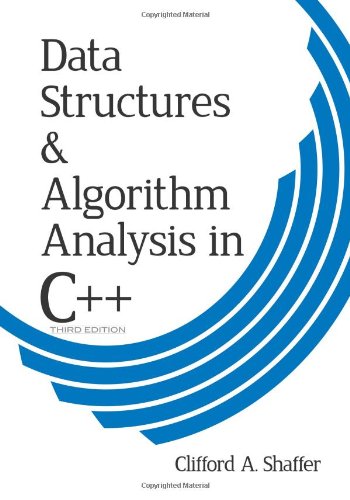
Data Structures and Algorithm Analysis in C++

Data Structures and Algorithm Analysis in C++

By Clifford A. Shaffer
Publisher: Dover Publications 2012
ISBN/ASIN: 048648582X
ISBN-13: 9780486485829
Number of pages: 613
Description:
A comprehensive treatment focusing on the creation of efficient data structures and algorithms, this text explains how to select or design the data structure best suited to specific problems. It uses C++ as the programming language and is suitable for second-year data structure courses and computer science courses in algorithmic analysis.

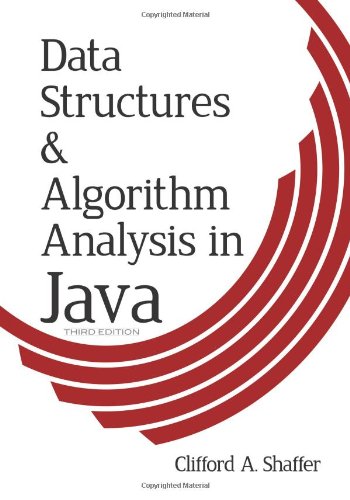
Data Structures and Algorithm Analysis in Java

Data Structures and Algorithm Analysis in Java

by Clifford A. Shaffer
Publisher: Dover Publications 2012
ISBN/ASIN: 0486485811
ISBN-13: 9780486485812
Number of pages: 601
Description:
A comprehensive treatment focusing on the creation of efficient data structures and algorithms, this text explains how to select or design the data structure best suited to specific problems. It uses Java as the programming language and is suitable for second-year data structure courses and computer science courses in algorithmic analysis.

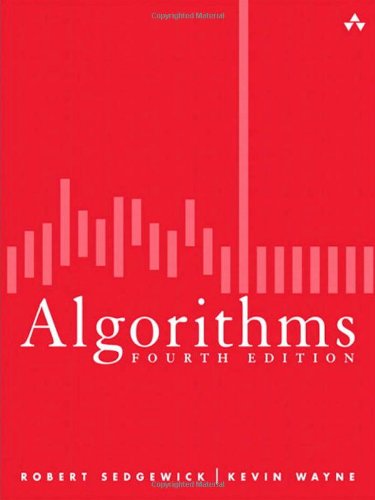
Algorithms

Algorithms

by Robert Sedgewick, Kevin Wayne
Publisher: Addison-Wesley Professional 2011
ISBN/ASIN: 032157351X
ISBN-13: 9780321573513
Number of pages: 976
Description:
This textbook surveys the most important algorithms and data structures in use today. Applications to science, engineering, and industry are a key feature of the text. We motivate each algorithm that we address by examining its impact on specific applications.

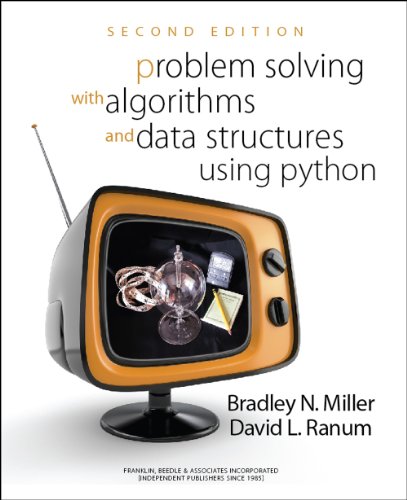
Problem Solving with Algorithms and Data Structures Using Python

Problem Solving with Algorithms and Data Structures Using Python

by Brad Miller, David Ranum
Publisher: Franklin, Beedle & Associates 2011
ISBN/ASIN: 1590282574
ISBN-13: 9781590282571
Number of pages: 438
Description:
This textbook is designed to serve as a text for a first course on data structures and algorithms, typically taught as the second course in the computer science curriculum. We cover abstract data types and data structures, writing algorithms, and solving problems.

Friday, August 2, 2013

A Practical Introduction to Data Structures and Algorithm Analysis Third Edition (C++ Version)

A Practical Introduction to Data Structures and Algorithm Analysis Third Edition (C++ Version) 

Author : Clifford A. Shaffer, Department of Computer Science, Virginia Tech 
Publication Date : January 2010 

We study data structures so that we can learn to write more efficient programs. But why must programs be efficient when new computers are faster every year? The reason is that our ambitions grow with our capabilities. Instead of rendering efficiency needs obsolete, the modern revolution in computing power and storage capability merely raises the efficiency stakes as we computerize more complex tasks. 

The quest for program efficiency need not and should not conflict with sound design and clear coding. Creating efficient programs has little to do with "programming tricks" but rather is based on good organization of information and good algorithms. A programmer who has not mastered the basic principles of clear design is not likely to write efficient programs. Conversely, "software engineering" cannot be used as an excuse to justify inefficient performance. Generality in design can and should be achieved without sacrificing performance, but this can only be done if the designer understands how to measure performance and does so as an integral part of the design and implementation process. Most computer science curricula recognize that good programming skills begin with a strong emphasis on fundamental software engineering principles. Then, once a programmer has learned the principles of clear program design and implementation, the next step is to study the effects of data organization and algorithms on program efficiency.

CLICK HERE

Wednesday, June 26, 2013

A Tutorial Introduction to GNU Emacs

A Tutorial Introduction to GNU Emacs

Introduction and History


GNU Emacs is a free, portable, extensible text editor. That it is free means specifically that the source code is freely copyable and redistributable. That it is portable means that it runs on many machines under many different operating systems, so that you can probably count on being able to use the same editor no matter what machine you're using. That it is extensible means that you can not only customize all aspects of its usage (from key bindings through fonts, colors, windows, mousage and menus), but you can program Emacs to do entirely new things that its designers never thought of.
Because of all this, Emacs is an extremely successful program, and does more for you than any other editor. It's particularly good for programmers. If you use a common programming language, Emacs probably provides a mode that makes it especially easy to edit code in that language, providing context sensitive indentation and layout. It also probably allows you to compile your programs inside Emacs, with links from error messages to source code; debug your programs inside Emacs, with links to the source; interact directly with the language interpretor (where appropriate); manage change logs; jump directly to a location in the source by symbol (function or variable name); and interact with your revision control system.

CLICK HERE

Tuesday, June 25, 2013

XEmacs Tutorial Introduction

XEmacs Tutorial Introduction

Sarah Waterson

 You should be reading this document using a browser such as Netscape. In addition, you will be running XEmacs so that you can try out the commands given here. Don't worry! If you don't know how to start XEmacs yet, you will soon. It is very important that you follow the instructions closely and accurately. READ EVERYTHING! Occasionally you will be asked to type some Unix commands in an xterm window, so you should make sure that you have an xterm window open as well. 


CLICK HERE

Friday, June 21, 2013

Guide to Writing SE Linux Policy

Guide to Writing SE Linux Policy

Faye Coker

This document continues on from the Getting Started with SE Linux HOWTO, and covers writing SE Linux policy as well as discussing configuration files you will be dealing with. It is aimed at people starting out with writing their own SE Linux policies. If you have not already done so, please read the Getting Started with SE Linux HOWTO in order to become familiar with basic concepts. Any mention of "old SE Linux" refers to the original release of SE Linux for 2.4.x kernels. "New SE Linux" refers to SE Linux for 2.6.x kernels for which a backport is available for 2.4.
Please make sure you also read the NSA's document called Configuring the SE Linux Policy as material in this HOWTO refers to its contents.
This HOWTO tries to be as basic as possible. With learning how to write SE Linux policy, it's mostly a matter of just getting in there and doing it, as many things are not documented at this time. Keep practising, look at existing policies, study the kernel log messages. A lot of what you try might be guesswork which is perfectly okay, because things will gradually fall in to place.
This document has been tested on a test system but more guinea pigs are always welcome.

CLICK HERE
 

Secure Programming for Linux and Unix HOWTO

Secure Programming for Linux and Unix HOWTO

David A. Wheeler

This book provides a set of design and implementation guidelines for writing secure programs for Linux and Unix systems. Such programs include application programs used as viewers of remote data, web applications (including CGI scripts), network servers, and setuid/setgid programs. Specific guidelines for C, C++, Java, Perl, PHP, Python, Tcl, and Ada95 are included.


CLICK HERE

Securing and Hardening Red Hat Linux Production Systems

Securing and Hardening Red Hat Linux Production Systems

A Practical Guide to Basic Linux Security in Production Enterprise Environments

Written by Werner Puschitz
 
This Linux Security HOWTO is intended for a technical audience, Linux system administrators, and security people in corporations and organizations that have to use commercial Linux distributions for their production environment. If you are a Linux expert then you may find familiar material here, but you will have difficulties to find documentation on various topics like restricting su access to system and shared accounts only as covered in this article, see Restricting su Access to System and Shared Accounts.
If you need to make Linux production systems compliant with various audit requirements, then this article should offer a good baseline and starting point. The main objective of this Linux Security guide is to discuss basic Linux security requirements including account policies for production systems that are being audited. This document covers various system services like SSH which are usually enabled and required on all Linux production servers. But it does not cover services or applications like Apache, Samba etc., since these applications/services are usually not needed across all Linux servers and should therefore not be installed on all systems. In fact, these applications warrant their own security HOWTO. Also, this article does not cover security features that require kernel patching. This is not an option for most companies due to vendor support issues. 
 
CLICK HERE

Linux Security Administrator's Guide

Linux Security Administrator's Guide

Dave Wreski

 This document is a general overview of security issues that face the administrator of Linux systems. It covers general security philosophy and a number of specific examples of how to better secure your Linux system from intruders. Also included are pointers to security related material and programs.


CLICK HERE

Linux Packet Filtering and iptables

Linux Packet Filtering and iptables

Oskar Andreasson


Why this document was written

Well, I found a big empty space in the HOWTO's out there lacking in information about the iptables and Netfilter functions in the new Linux 2.4.x kernels. Among other things, I'm going to try to answer questions that some might have about the new possibilities like state matching. Most of this will be illustrated with an example rc.firewall.txt file that you can use in your /etc/rc.d/ scripts. Yes, this file was originally based upon the masquerading HOWTO for those of you who recognize it.

CLICK HERE

Table of Contents - Linux Security for Beginners

Table of Contents - Linux Security for Beginners

There is a saying in the security world that the only truly safe computer system is one that is disconnected from the network, switched off and buried six feet under ground. The sentiment may be somewhat true but it is hardly a practical solution to the problems we face today in protecting servers and desktops from outside intrusion.
There are more computer systems connected to the internet either directly or via local area networks than at any time in the history of technology and the numbers are growing at a rapid rate. It seems that not a month goes by without another story in the news about the internal network of a major corporation being compromised by an intruder. 
The simple fact is that there really is no such thing as a truly secure system as long is it is connected to a network. If the large corporations with expensive firewalls and talented IT staff can’t always stop criminals from breaking in what chance do the rest of us have?
Fortunately all is not lost and we do not have to pull the network cables out of the back of our computer systems. With careful planning and system configuration it is quite possible to create a secure environment that will cause the hacker to move on to the next, easier target without rendering the entire system useless. 


Building Internet Firewalls .

Building Internet Firewalls
By D. Brent Chapman & Elizabeth D. Zwicky; ISBN 1-56592-124-0, 517 pages.
First Edition, November 1995.


CLICK HERE

Linux Administrator's Security Guide

Linux Administrator's Security Guide

Author: Kurt Seifried

What is computer security?

Security is risk management. - unknown
"A computer is secure if you can depend on it and it's software to behave as you expect" - Practical UNIX and Internet Security
Security is: availability, consistency, access control, data confidentiality, authentication. 
"The principal objective of computer security is to protect and assure the confidentiality, integrity, and availability of automated information systems and the data they contain."
There are numerous definitions for "computer security", and most of them are correct. Essentially computer security means enforcement of usage policies, this must be done since people and software have flaws that can result in accidents, but also because someone may want to steal your information, use your resources inappropriately or simply deny you the use of your resources.

CLICK HERE

Securing Debian Manual

Securing Debian Manual 

 This document describes security in the Debian project and in the Debian operating system. Starting with the process of securing and hardening the default Debian GNU/Linux distribution installation, it also covers some of the common tasks to set up a secure network environment using Debian GNU/Linux, gives additional information on the security tools available and talks about how security is enforced in Debian by the security and audit team. 

Wednesday, June 19, 2013

Network Security Tools

Network Security Tools


This concise, high-end guide shows experienced administrators how to customize and extend popular open source security tools such as Nikto, Ettercap, and Nessus. It also addresses port scanners, packet injectors, network sniffers, and web assessment tools. Network Security Tools is the one resource you want at your side when locking down your network. 

Saturday, June 15, 2013

The Design and Implementation of the 4.4BSD Operating System

The FreeBSD Corporate Networker's Guide

FreeBSD system programming

FreeBSD system programming

Nathan Boeger 

 Mana Tominaga 


Welcome to the FreeBSD System Programming book. Please note that this is a work in progress and feedback is appreciated! please note a few things first:
  • We have written the book in a new format. I have read many programming books that have covered many different areas. Personally, I found it hard to follow code with no comments or switching back and forth between text explaining code and the code. So in this book, after chapter 1, I have split the code and text into separate pieces. The source code for each chapter is online and fully downloaded able. That way if you only want to check out the source code examples you can view them only. And if you want to understand the concepts you can read the text or even have them side by side. Please let us know your thoughts on this
  • The book was ordinally intended to be published in hard copy form. However, this has changed and the book was converted using txt2html and some quick edits by hand. Therefore you might find that the HTML formatting is not consistent or hard to follow. We would like feedback on this. Please let us know what style would be the easiest to read.
  • If you would like to participate please contact the authors.You can view the work online or choose to download the chapter as txt.
  • Contributors:
    Francis Gudin (updates to Chapter 1, 2, 3, 4, 5, 6, 7, and 8)
    Ceri Davies (converting to DocBook)
CLICK HERE


The Linux+FreeBSD mini-HOWTO

The Linux+FreeBSD mini-HOWTO

Niels Kristian Bech Jensen


 This document describes how to use Linux and FreeBSD on the same system. It introduces FreeBSD and discusses how the two operating systems can cooperate, e.g. by sharing swap space. You should probably have some experience with Linux or FreeBSD and hard drive partitioning (fdisk) before you read this document. The tips herein are tested using FreeBSD 2.2.2, but they should be valid for newer versions as well. Do not hesitate to mail me if you have comments, questions or suggestions about this document. I would also like to hear from people who have experience using Linux together with NetBSD or OpenBSD.

CLICK HERE

FreeBSD Developers' Handbook

FreeBSD Developers' Handbook


Welcome to the Developers' Handbook. This manual is a work in progress and is the work of many individuals. Many sections do not yet exist and some of those that do exist need to be updated. If you are interested in helping with this project, send email to the FreeBSD documentation project mailing list.
The latest version of this document is always available from the FreeBSD World Wide Web server. It may also be downloaded in a variety of formats and compression options from the FreeBSD FTP server or one of the numerous mirror sites.

CLICK HERE

Thursday, June 13, 2013

Motif Programming Manual, Vol 6A, 2nd Edition

Motif Programming Manual, Vol 6A, 2nd Edition

By David Brennan, Dan Heller, Paula Ferguson

Publisher: O'Reilly Media

Released: September 1993

Pages: 1014


The Motif Programming Manual is a source for complete, accurate, and insightful guidance on Motif application programming. There is no other book that covers the ground as thoroughly or as well as this one. The book has been updated to Motif 1.2, but is still usable with Motif 1.1.
The Motif Programming Manual describes how to write applications using the Motif toolkit from the Open Software Foundation (OSF). The book goes into detail on every Motif widget class, with useful examples that will help programmers to develop their own code. Anyone doing Motif programming who doesn't want to have to figure it out on their own needs this book.
In addition to information on Motif, the book is full of tips about programming in general and about user interface design.
Contents include:
  • An introduction to the Motif programming model, how it is based on the X Toolkit Intrinsics, and how it differs from them.
  • Chapters on each of the Motif widget classes, explaining them in depth, with useful examples that will help you to improve your own code. For example, the chapter on menus shows how to develop utility functions that generalize and simplify menu creation. All of the code shown in the book is available free of charge over the Internet or via UUCP.
  • Coverage of the drag-and-drop mechanism for transferring data. Two extensive examples show how to implement custom drag source and drop site functionality in a Motif application.
  • A tutorial on UIL. The chapters on UIL describe all of the techniques used to create an interface with this prototyping tool. The numerous examples cover the basics and explore ways to use UIL to facilitate rapid prototyping.
  • ,/ul>The book assumes competence with the C programming language, as well as familiarity with fundamental X Window System concepts. The Motif Programming Manual is not only the most comprehensive guide to writing applications with Motif, it is an integral part of the most widely used series of books on X as a whole. It complements and builds upon the earlier books in the X Window System Series from O'Reilly & Associates, as well as on OSF's own Motif Style Guide. Best when paired with Volume 6B, Motif Reference Manual.

 CLICK HERE

AIXwindows Programming Guide

AIXwindows Programming Guide

AIX 5L Version 5.1
AIXwindows Programming Guide
Third Edition (April 2001)

Highlighting

The following highlighting conventions are used in this book:

Bold Identifies commands, subroutines, keywords, files, structures, directories, and other items whose names are predefined by the system. Also identifies graphical objects such as buttons, labels, and icons that the user selects.
Italics Identifies parameters whose actual names or values are to be supplied by the user.
Monospace Identifies examples of specific data values, examples of text similar to what you might see displayed, examples of portions of program code similar to what you might write as a programmer, messages from the system, or information you should actually type.

 CLICK HERE

Basic Graphics Programming With The Xlib Library

Basic Graphics Programming With The Xlib Library


This tutorial is the first in a series of "would-be" tutorials about graphical programming in the X window environment. By itself, it is useless. A real X programmer usually uses a much higher level of abstraction, such as using Motif (or its free version, lesstiff), GTK, QT and similar libraries. However, we need to start somewhere. More than this, knowing how things work down below is never a bad idea.
After reading this tutorial, one would be able to write very simple graphical programs, but not programs with a descent user interface. For such programs, one of the previously mentioned libraries would be used.

CLICK HERE

Motif Programming

Motif Programming

A. D. Marshall 1998/9

This book introduces the fundamentals of Motif programming and addreses wider issues concerning the X Window system. The aim of this book is to provide a practical introduction to writing Motif programs. The key principles of Motif programming are always supported by example programs.
The X Window system is very large and this book does not attempt to detail every aspect of either X or Motif. This book is not intended to be a complete reference on the subject.
The book is organised into logical parts, it begins by introducing the X Window system and Motif and goes on to study individual components in detail in specific Chapters. In the remainder of this Chapter we concentrate on why Motif and related areas are important and give a brief history of the development of Motif.

Xlib programming: a short tutorial

Xlib programming: a short tutorial

I haven't found anything very satisfying on the Web as an Xlib tutorial. Many of them are too much Motif-oriented for my taste. Furthermore, I answer questions about X programming almost daily, so I've started to put together some small coursewares.

Important note:

the example programs are written in C++, but this is mainly for the ability to declare variables anywhere.

CLICK HERE

Xlib programming manual

Xlib programming manual


CLICK HERE

X Window and Motif Programming Guide (D. Marshall)

X Window and Motif Programming Guide (D. Marshall)


CLICK HERE

An Introduction to Tkinter

An Introduction to Tkinter

Fredrik Lundh


The Tkinter module ("Tk interface") is the standard Python interface to the Tk GUI toolkit from Scriptics (formerly developed by Sun Labs).
Both Tk and Tkinter are available on most Unix platforms, as well as on Windows and Macintosh systems. Starting with the 8.0 release, Tk offers native look and feel on all platforms.
Tkinter consists of a number of modules. The Tk interface is located in a binary module named _tkinter (this was tkinter in earlier versions). This module contains the low-level interface to Tk, and should never be used directly by application programmers. It is usually a shared library (or DLL), but might in some cases be statically linked with the Python interpreter.
In addition to the Tk interface module, Tkinter includes a number of Python modules. The two most important modules are the Tkinter module itself, and a module called Tkconstants. The former automatically imports the latter, so to use Tkinter, all you need to do is to import one module:
    import Tkinter
Or, more often:
    from Tkinter import *
 
CLICK HERE 

X Window System Architecture Overview HOWTO

X Window System Architecture Overview HOWTO

Daniel Manrique


 This document provides an overview of the X Window System's architecture, give a better understanding of its design, which components integrate with X and fit together to provide a working graphical environment and what choices are there regarding such components as window managers, toolkits and widget libraries, and desktop environments.


CLICK HERE

Wednesday, June 12, 2013

Cygwin User's Guide

Cygwin User's Guide


Cygwin is a Linux-like environment for Windows. It consists of a DLL (cygwin1.dll), which acts as an emulation layer providing substantial POSIX (Portable Operating System Interface) system call functionality, and a collection of tools, which provide a Linux look and feel. The Cygwin DLL works with all x86 and AMD64 versions of Windows NT since Windows XP SP3. The API follows the Single Unix Specification as much as possible, and then Linux practice. The major differences between Cygwin and Linux is the C library (newlib instead of glibc).
With Cygwin installed, users have access to many standard UNIX utilities. They can be used from one of the provided shells such as bash or from the Windows Command Prompt. Additionally, programmers may write Win32 console or GUI applications that make use of the standard Microsoft Win32 API and/or the Cygwin API. As a result, it is possible to easily port many significant UNIX programs without the need for extensive changes to the source code. This includes configuring and building most of the available GNU software (including the development tools included with the Cygwin distribution).

CLICK HERE

GTK+ 3 Reference Manual

GTK+ 3 Reference Manual

GTK+ is the primary library used to construct user interfaces in GNOME applications. It provides user interface controls and signal callbacks to control user interfaces.


CLICK HERE

Grokking the GIMP

Grokking the GIMP

by
Carey Bunks
Grokking the GIMP  

Book Overview

The first part of this book focuses on mastering core tools: layers, selections, masks, and colorspaces. The second part builds on the first by presenting an in-depth treatment of touchup, enhancement, compositing, rendering, and image creation for the web. The following gives a synopsis of what you will find in each chapter.
Chapter 1 reviews the GIMP basics. It introduces the GIMP dialogs, reviews window features, and explains a host of functions that are basic but should not be taken for granted. An experienced GIMP user could quickly flip through this chapter of the book, especially if he or she's already familiar with the main features of version 1.2.
Chapter 2 covers layers. Layers are the fundamental building blocks of the GIMP. They are the image unit that plays the most important role in our work, and it is important to understand them and the functions that manipulate them. Even if you are already familiar with layers, this chapter will be worth reviewing because it contains many insights into how to use layers efficiently and effectively.
Chapters 3 and 4 give a unified and in-depth presentation of selections and masks. To the casual observer selections and masks may seem like very different animals. However, they are really complementary implementations of the same thing. The goal of both is to isolate a part of an image. Selections do this by selecting a group of pixels in the image, and masks do it by masking some pixels, leaving the rest exposed. Thus, selections are masks, and masks are selections. These two chapters explain how selections and masks can be made to work efficiently and effectively together.
Because selections are often the most time-consuming part of any project, Chapter 3 compares the different selection tools and describes the applications for which each is best suited. Chapter 4 makes the conceptual link from selections to masks. This chapter describes a host of advanced mask techniques, including methods for refining selection edges and a super technique for finding natural masks you won't want to miss.
Chapter 5 adds the final component of our basic skill set by describing colorspaces and the tools used to get results with color. The first half of this chapter is conceptual, covering RGB and HSV colorspaces. The second half covers the GIMP's blending modes. These are often poorly understood and under-utilized by beginning users. As will be seen in later chapters, the blending modes are valuable tools, without which many needed operations would be quite impossible. The material covered in this chapter is critical for color correction, compositing, rendering, and web graphics... the entire second half of the book! The chapter's intuitive approach explains the aspects of color theory you'll need for your GIMP projects.
Chapter 6 presents techniques for photo touchup and enhancement. The main feature of this chapter is the use of Curves, a poorly understood but amazingly powerful tool. I think that the material covered in this chapter alone is worth the price of the book. In addition to the use of Curves, this chapter also covers the use of the Clone tool for the elimination of blemishes and the use of a sharpening filter, oddly named Unsharp Mask.
One of the most interesting, fun, and useful uses of the GIMP is compositing. Compositing is collage, photo montage, and all the techniques that go with these. Compositing is probably the premiere use of an image manipulation program such as the GIMP, and Chapter 7 covers this topic in detail. This chapter more than any other depends on using the methods and techniques presented in the earlier chapters and is strongly oriented around project work. The projects show how to effectively use selections, masks, and color correction techniques, among other tools, to achieve terrific compositing results.
Chapter 8 describes the tools and techniques for creating shadows, punchouts, and bevels. In addition, it gives an in-depth description of the Emboss and Bump map filters. These are powerful tools for creating 3D effects in images
Chapter 9 is the final chapter of this book. It covers some of the most useful features in the GIMP for Internet web applications. This chapter describes tools for creating animated GIFs and clickable image maps. It also covers several other topics that are required reading for anyone creating graphics for the web.


Volume 3: OPEN LOOK User's Guide

Volume 3: OPEN LOOK User's Guide

Ian Darwin, Valerie Quercia, and Tim O'Reilly
Unpublished, 1993


I started working on Volume 3: OPEN LOOK in the eary 1990s, when Sun made the XView source code freely available. (Please remember this: it really was the world's first open source commercial toolkit for the X Window System; "Open Motif" came almost two decades later, after the freeware QT and GTK toolkit were in wide circulation.)
As the 1990s rolled on, the Unix industry came to a pitched battle between Motif (backed by IBM, DEC, HP, and SCO) and OPEN LOOK (backed by Sun and AT&T).
Around 1993, I finished the book, and happened to be travelling to California so I delivered the manuscript for review to Tim O'Reilly in person, in his office an hour north of San Francisco. He looked at it, and said something like, "So, did you hear about the announcement on Tuesday?" In response to my blank stare, he related that Sun had capitulated on OPEN LOOK in return for the other vendors capitulating on Sun's desktop tools (Calendar Manager &c, plus the ToolTalk technology underlying it), and the vendors had all joined together to form the Common Open Systems Environment group, whose first project was to be the Common Desktop Environment (CDE). And it was to be based on Motif, not OPEN LOOK.
The upshot was that Volume 3: OPEN LOOK never was published, despite a long period of indecision. (Tim asked readers in their then-hardcopy magazine/catalog if they thought it should be published, but results were inconclusive.)
Finally, in 1995, I decided to take the bull by the horns and publish an XView and OPEN LOOK CD-ROM. I got permission from O'Reilly & Associates to include Vol3 OL and Vol 7A and 7B, collected as much other OPEN LOOK stuff as I could, including the example code from competing publishers' books, and burned a CD. I had a few hundred copies pressed, and I sold it over the net for the rest of the 1990s. It only sold a few hundred copies, and the last copy sold in 2002. It never caught on in a big way, for some reason. There are, of course, a lot of "could have, should have" items here, but rather than dwell on them, I'm simply releasing it for free to benefit anybody who still uses OPEN LOOK.


Tuesday, June 11, 2013

XEmacs Tutorial Table of Contents

XEmacs Tutorial Table of Contents


How To Use This Document

You should be reading this document using a browser such as Netscape. In addition, you will be running XEmacs so that you can try out the commands given here. Don't worry! If you don't know how to start XEmacs yet, you will soon. It is very important that you follow the instructions closely and accurately. READ EVERYTHING! Occasionally you will be asked to type some Unix commands in an xterm window, so you should make sure that you have an xterm window open as well. The following icons are used to help you move through this tutorial:


The keyboard icon indicates that input is expected from you. Most of the time you will be asked to input something into an XEmacs window. Pay close attention to the instructions! Sometimes you will be switching over to an xterm window for input. 

The left arrow will take you to the PREVIOUS page of the turorial. 

The right arrow is the CONTINUE arrow. It will take you to the next page of the tutorial. 

A TABLE OF CONTENTS is provided for more flexible movement and is accessible from the bottom of each page via this UP arrow icon. 
If you are brand new to XEmacs, it is recommended that you follow the CONTINUE links at the bottom of each page sequentially, as the tutorial is organized into one continuous lesson. 

CLICK HERE

The Official Samba-3 HOWTO and Reference Guide

The Official Samba-3 HOWTO and Reference Guide

John H. Terpstra

and

Jelmer R. Vernooij

 Samba is a big, complex project. The Samba project is ambitious and exciting. The team
behind Samba is a group of some thirty individuals who are spread the world over and
come from an interesting range of backgrounds. This team includes scientists, engineers,
programmers, business people, and students.
Team members were drawn into active participation through the desire to help deliver
an exciting level of transparent interoperability between Microsoft Windows and the non-
Microsoft information technology world.
The slogan that unites the efforts behind the Samba project says: Samba, Opening Windows
to a Wider World! The goal behind the project is one of removing barriers to interoperability.
Samba provides file and print services for Microsoft Windows clients. These services may be
hosted off any TCP/IP-enabled platform. The original deployment platforms were UNIX
and Linux, though today it is in common use across a broad variety of systems.


Samba-3 by Example Practical Exercises to Successful Deployment

Samba-3 by Example Practical Exercises to Successful Deployment
 

Second Edition
John H. Terpstra

The cover artwork of this book continues the freedom theme of the first edition of “Samba-3
by Example.” The history of civilization demonstrates the fragile nature of freedom. It can
be lost in a moment, and once lost, the cost of recovering liberty can be incredible. The previous
edition cover featured Alfred the Great who liberated England from the constant assault
of Vikings and Norsemen. Events in England that finally liberated the common people
came about in small steps, but the result should not be under-estimated. Today, as always,
freedom and liberty are seldom appreciated until they are lost. If we can not quantify what
is the value of freedom, we shall be little motivated to protect it.
Samba-3 by Example Cover Artwork: The British houses of parliament are a symbol of the
Westminster system of government. This form of government permits the people to govern
themselves at the lowest level, yet it provides for courts of appeal that are designed to
protect freedom and to hold back all forces of tyranny. The clock is a pertinent symbol of
the importance of time and place.
The information technology industry is being challenged by the imposition of new laws,
hostile litigation, and the imposition of significant constraint of practice that threatens
to remove the freedom to develop and deploy open source software solutions. Samba is a
software solution that epitomizes freedom of choice in network interoperability for Microsoft
Windows clients.
I hope you will take the time needed to deploy it well, and that you may realize the greatest
benefits that may be obtained. You are free to use it in ways never considered, but in doing
so there may be some obstacles. Every obstacle that is overcome adds to the freedom you
can enjoy. Use Samba well, and it will serve you well.


CLICK HERE

Using Samba

Using Samba

Robert Eckstein, David Collier-Brown, Peter Kelly

1st Edition November 1999


This book, which has been officially adopted by the Samba team under an open content license, is a comprehensive guide to Samba administration, including such recent additions as integration with Windows NT domains and the SWAT graphic configuration tool.
Samba is a cross-platform triumph: it turns a Unix or Linux system into a file and print server for Microsoft Windows network clients. Now you can let users store their files (and even important executables) in a single place for easy sharing and backup, protected by Unix or NT security mechanisms, and still offer such transparent access that PC users don't even realize they're going to another system. The magic behind Samba is that it recognizes and speaks the SMB protocol developed by Microsoft for file and printer sharing on its own systems.
Basic Samba configuration is simple, but you'll want to make sure your security settings are just right and find out about the full range of options (how do you like your filenames mangled?). Trouble-shooting, security, connectivity, performance, and logging are thoroughly covered with examples in this book.
Samba is so robust, flexible, and secure that many people are choosing it over Windows NT for their file and print services. Furthermore, Samba is proving to be a necessity for the many organizations that have an existing Unix or Linux system and want to tie in PCs running Microsoft software. Samba is also open source software, licensed under the GNU General Public License.
The authors present the most common configurations and problems in an easy-to-follow manner, along with instructions for getting the most out of Samba. Whether you're playing on one note or a full three-octave range, this book will give you an efficient and secure server. The included CD-ROM holds sources and ready-to-install binaries, plus other useful information.


Using Samba, 2nd Edition

Using Samba, 2nd Edition

By Jay Ts, Robert Eckstein, David Collier-Brown

Publisher: O'Reilly Media

Released: February 2003

Pages: 560


This book, which has been officially adopted by the Samba Team and is under the GNU Free Documentation License (FDL), is a comprehensive guide to Samba administration. The 2nd edition focuses on Samba 2.2 and covers the most important features of 3.0, which was under development as this book went to print.
Samba is a cross-platform triumph: it turns a Unix or Linux system into a file and print server for Microsoft Windows network clients. Samba is so robust, flexible, fast, and secure that many people are choosing it over Windows NT/2000/XP for their file and print services. Samba is also free software, licensed under the GNU General Public License.
This book will help you make file and print sharing as robust, powerful, and efficient as possible. The authors delve into the internals of the Windows activities and protocols to an unprecedented degree, explaining the strengths and weaknesses of each feature in Windows domains and in Samba itself.
Using Samba takes you from basic installation and configuration--on both the client and server side, for a wide range of systems--to subtle details of security, cross-platform compatibility, and resource discovery that make the difference between whether a user sees the folder they expect or a cryptic error message.
The range of this book knows few bounds. Wondering how to integrate Samba's authentication with that of a Windows PDC? How to get Samba to serve Microsoft Dfs shares? How to share files on Mac OS X? These and a dozen other issues of interest to system administrators are covered. A whole chapter is dedicated to troubleshooting.
Whether you're playing on one note or a full three-octave range, on your personal computer or an enterprise network, Using Samba will give you an efficient and secure server.

CLICK HERE